How Can You Learn to Tell Your Story Better Have you ever shared a personal experience, only to watch people’s attention drift away halfway through?
Or maybe you’ve listened to someone tell a story so well that you felt completely immersed, hanging on every word.
The difference isn’t usually the story itself.
It’s how the story is told.
Whether you’re speaking in a job interview, writing a blog post, creating content on social media, giving a presentation, building a personal brand, or simply connecting with friends, storytelling is one of the most valuable communication skills you can develop.
The good news?
Great storytellers aren’t born with a magical talent. Storytelling is a skill that can be learned, practiced, and improved over time.
If you’ve ever wondered how can you learn to tell your story better, this guide will walk you through practical techniques used by successful speakers, writers, marketers, leaders, entrepreneurs, and content creators. You’ll discover how to make your stories more engaging, emotional, memorable, and impactful.
Quick Answer Box
How can you learn to tell your story better?
You can learn to tell your story better by understanding your audience, focusing on a clear message, adding emotional details, using a structured beginning-middle-end format, practicing regularly, and eliminating unnecessary information. Strong storytelling combines authenticity, clarity, and emotion to keep listeners engaged and make your message memorable.
How Can You Learn to Tell Your Story Better by Understanding Great Stories
One of the first steps in understanding how can you learn to tell your story better is recognizing what makes stories memorable.
Most memorable stories contain:
- A relatable character
- A challenge or conflict
- Emotional moments
- A lesson or transformation
- A satisfying outcome
People don’t remember facts as easily as they remember stories.
That’s why storytelling is used in:
- Business presentations
- Marketing campaigns
- Interviews
- Public speaking
- Social media content
- Books and movies
- Personal branding
A good story makes people feel something.
Why Learning How Can You Learn to Tell Your Story Better Matters Today
In 2026, attention spans are shorter than ever.
People scroll quickly.
They skip advertisements.
They ignore boring content.
Stories cut through the noise because they create emotional connections.
Benefits of strong storytelling include:
- Better communication skills
- Stronger relationships
- Increased influence
- More engaging content
- Improved leadership
- Better public speaking
- Enhanced personal branding
- Greater audience retention
People may forget your exact words, but they’ll remember how your story made them feel.
How Can You Learn to Tell Your Story Better With a Clear Purpose
Every great story has a purpose.
Before telling a story, ask yourself:
- What do I want people to learn?
- What emotion do I want them to feel?
- Why am I telling this story?
- What is the key takeaway?
Without a purpose, stories often become confusing or forgettable.
A clear purpose acts as your storytelling compass.
Know Your Audience
One of the biggest storytelling mistakes is telling the same story to everyone.
Different audiences care about different things.
For example:
Job Interview Audience
Interested in:
- Skills
- Results
- Problem-solving
Customers
Interested in:
- Benefits
- Outcomes
- Success stories
Friends
Interested in:
- Entertainment
- Emotions
- Personal experiences
Social Media Followers
Interested in:
- Relatable moments
- Quick lessons
- Authenticity
The better you understand your audience, the stronger your story becomes.
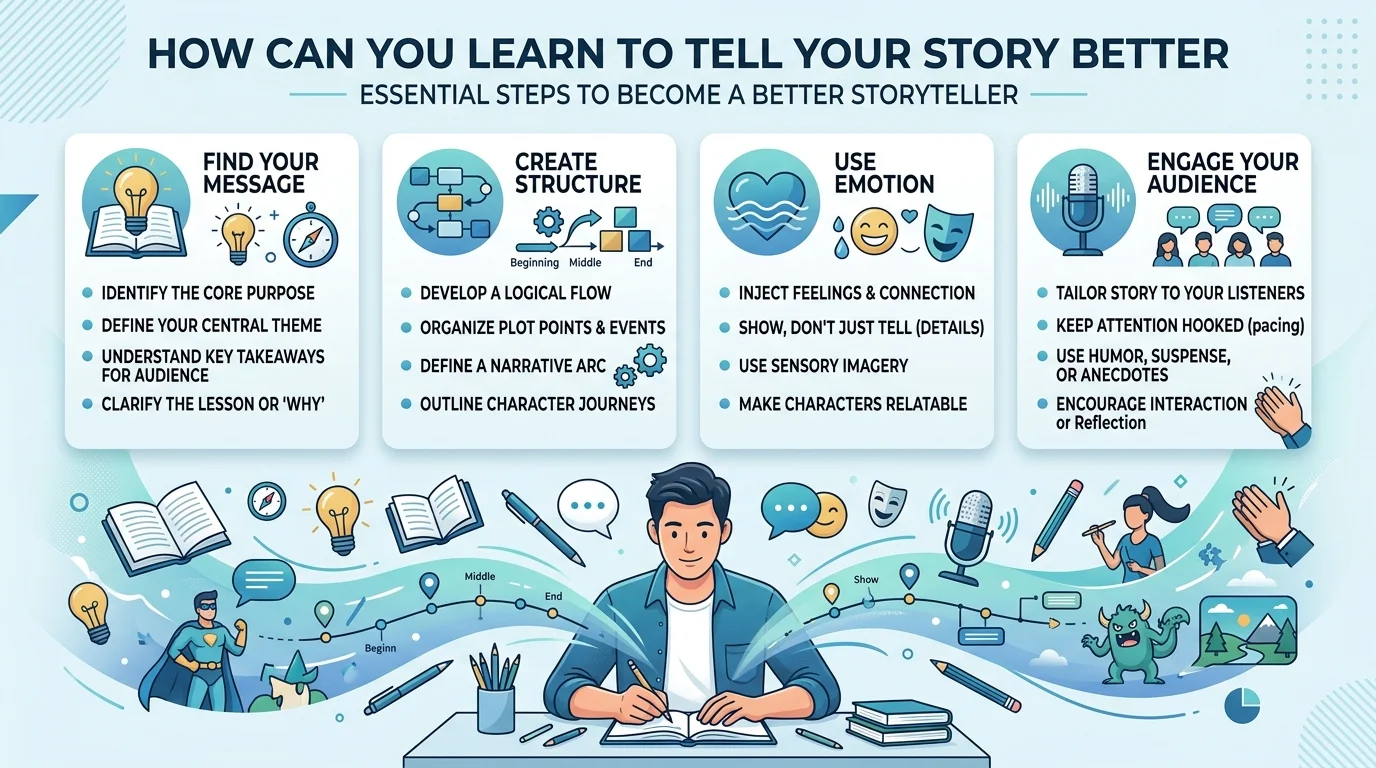
How Can You Learn to Tell Your Story Better Using Story Structure
The simplest storytelling structure remains one of the most effective.
Beginning
Introduce:
- The situation
- The setting
- The main character
Middle
Present:
- The challenge
- The conflict
- The obstacle
End
Reveal:
- The solution
- The lesson learned
- The transformation
This structure works because our brains naturally process information through narratives.
Add Emotion to Your Story
Facts inform.
Emotions connect.
Compare these examples:
Weak Version
- I started a business and faced challenges.
Strong Version
- I sat alone at my kitchen table wondering how I’d pay my bills after my business failed.
Which one feels more engaging?
Emotion creates connection.
Use feelings such as:
- Excitement
- Fear
- Hope
- Frustration
- Joy
- Relief
- Determination
Authentic emotion makes stories memorable.
Show, Don’t Just Tell
A common storytelling rule is:
Show, don’t tell.
Instead of saying:
- I was nervous.
Show it:
- My hands shook as I walked toward the stage.
Instead of saying:
- It was a busy day.
Show it:
- My phone buzzed nonstop while emails piled up faster than I could answer them.
Specific details help people visualize your story.
Focus on One Main Message
Many storytellers try to include everything.
The result?
A confusing story.
The strongest stories focus on one central idea.
Ask yourself:
- What is the main lesson?
- What should people remember?
- What is the key message?
Remove anything that doesn’t support that message.
Clarity beats complexity.
How Can You Learn to Tell Your Story Better Through Daily Practice
Storytelling improves through repetition.
Simple ways to practice:
- Journal daily experiences
- Record yourself speaking
- Share stories with friends
- Create social media content
- Write blog posts
- Participate in presentations
- Join speaking groups
Every story you tell becomes a learning opportunity.
How Can You Learn to Tell Your Story Better by Studying Great Storytellers
Pay attention to storytellers you admire.
Study:
- TED speakers
- Authors
- Podcasters
- Content creators
- Public speakers
- Comedians
Ask yourself:
- How do they open stories?
- How do they build suspense?
- How do they create emotion?
- How do they end strongly?
Success leaves clues.
Common Storytelling Mistakes to Avoid
Avoid these common errors:
Too Much Detail
Unnecessary information slows the story.
No Conflict
Without a challenge, stories feel flat.
Weak Endings
Every story should have a takeaway.
Lack of Emotion
Emotion drives engagement.
Being Too Generic
Specific details create memorable stories.
Talking Too Long
Keep stories focused and concise.
Practical Exercises for Learning How Can You Learn to Tell Your Story Better
Want faster improvement?
Try these exercises:
The One-Minute Story
Tell a complete story in 60 seconds.
Daily Highlight Exercise
Share the most interesting part of your day.
Lesson Story Exercise
Tell a story that teaches one lesson.
Before and After Story
Explain a transformation.
Emotional Detail Exercise
Add sensory details to a simple memory.
These exercises strengthen storytelling muscles quickly.
Did You Know?
Research consistently shows that stories are easier to remember than standalone facts because narratives engage multiple parts of the brain.
That’s why companies use storytelling in marketing, teachers use stories in education, and leaders use stories to inspire teams.
Stories make information stick.
How Can You Learn to Tell Your Story Better in Different Situations
Job Interviews
Focus on:
- Challenges
- Actions
- Results
Public Speaking
Focus on:
- Emotion
- Audience connection
- Clear lessons
Social Media
Focus on:
- Relatability
- Brevity
- Authenticity
Business
Focus on:
- Customer success
- Problem solving
- Outcomes
Personal Conversations
Focus on:
- Connection
- Entertainment
- Shared experiences
Frequently Asked Questions
How can you learn to tell your story better quickly?
The fastest way is through consistent practice. Focus on using a clear structure, adding emotional details, and sharing stories regularly. Feedback from others can also accelerate improvement.
Why is storytelling important?
Storytelling helps people connect emotionally with ideas and information. It improves communication, builds trust, increases engagement, and makes messages easier to remember.
What makes a story memorable?
Memorable stories typically include relatable characters, emotional moments, meaningful challenges, and a clear lesson or transformation that resonates with the audience.
Can storytelling be learned?
Yes. Storytelling is a skill rather than an inborn talent. Anyone can improve through practice, observation, feedback, and learning proven storytelling techniques.
How do I make my stories more engaging?
Use vivid details, emotional experiences, clear structure, and authentic moments. Focus on showing rather than telling whenever possible.
What is the biggest storytelling mistake?
Trying to include too much information. The best stories stay focused on one key message and remove details that don’t support the main point.
Conclusion
Learning how can you learn to tell your story better is one of the most valuable communication skills you can develop. Whether you’re speaking to an audience of thousands, writing content online, or simply connecting with one person, strong storytelling helps your message stand out and stay memorable.