

Response to Rude Customers A customer is yelling. Another leaves a rude comment online. Someone sends an aggressive email demanding an immediate solution.
Sound familiar?
Dealing with difficult people is part of customer service, but knowing the right response to rude customers can make the difference between escalating a conflict and turning a negative interaction into a positive outcome.
The truth is that rude customers are not always angry at you personally. They may be frustrated, stressed, confused, or disappointed. Your response can either fuel that frustration or help calm the situation.
Whether you work in retail, hospitality, customer support, healthcare, sales, or run your own business, mastering professional responses is one of the most valuable communication skills you can develop.
In this guide, you’ll discover practical customer service responses, professional scripts, polite comebacks, social media replies, and proven techniques that help you stay confident under pressure while protecting your brand and reputation.
Quick Answer Box
What is the best response to rude customers?
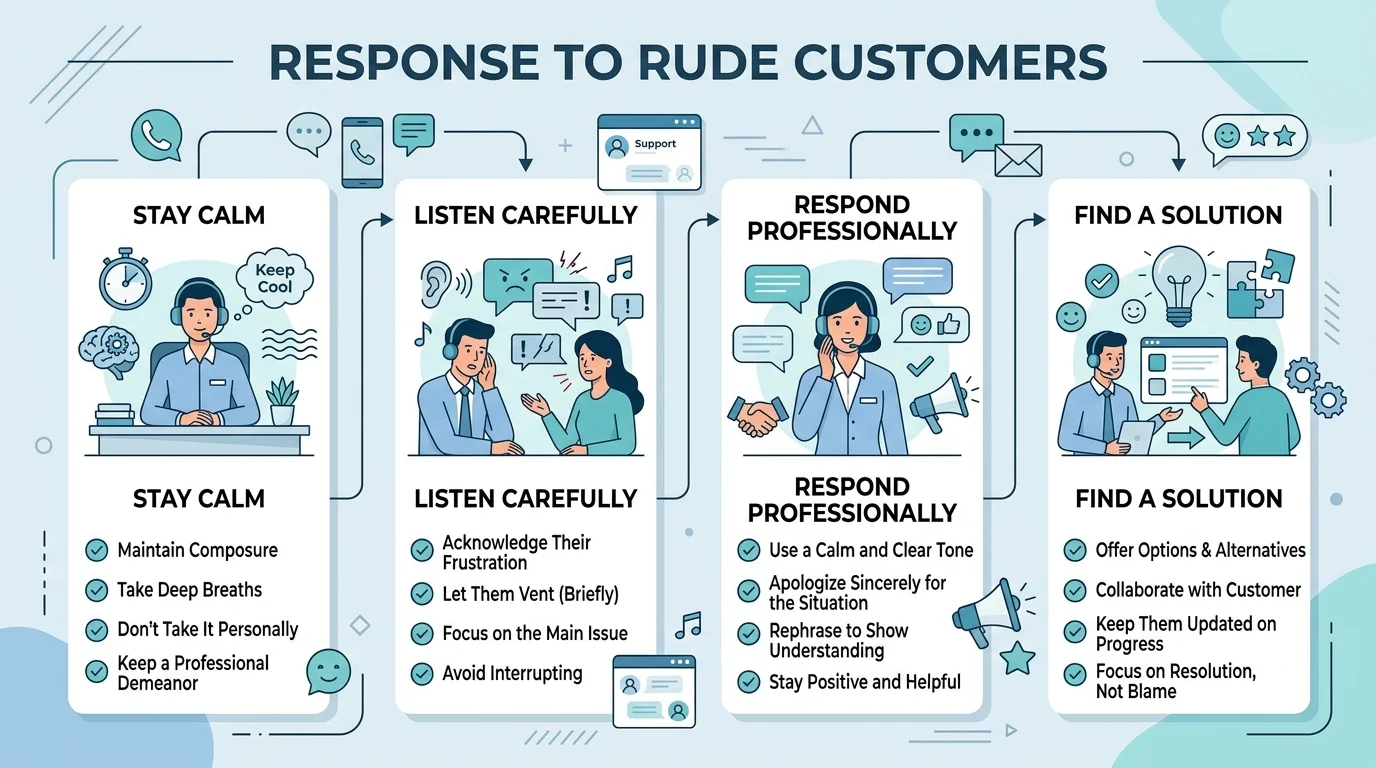
The best response to rude customers is to remain calm, acknowledge their concern, avoid arguing, and focus on finding a solution. Professional replies such as “I understand your frustration and I’d like to help resolve this” can de-escalate tension while maintaining respect and professionalism.
Understanding Response to Rude Customers
A professional response to rude customers is not about winning an argument.
It’s about:
- De-escalating conflict
- Protecting your reputation
- Solving the problem
- Maintaining professionalism
- Building trust
Remember:
Stay calm, stay respectful, and stay solution-focused.
Best General Response to Rude Customers Examples
Use these responses in most customer service situations:
- “I understand your concern.”
- “Let’s work together to resolve this.”
- “Thank you for bringing this to our attention.”
- “I appreciate your patience.”
- “I’d like to help find a solution.”
- “Let’s see what we can do.”
- “I hear your frustration.”
- “Thank you for explaining the issue.”
- “Let’s focus on resolving this.”
- “I’m here to help.”
When to Use These
Use these replies when:
- The customer is upset but still communicating.
- You need to calm the conversation.
- You want to shift focus toward solutions.
Vibe: Professional, respectful, solution-oriented.
Calm Response to Rude Customers in Professional Settings
These responses help maintain control.
- “I understand this situation is frustrating.”
- “Let’s review the details together.”
- “I appreciate your feedback.”
- “Thank you for your patience.”
- “I’d like to understand what happened.”
- “Let’s find the best solution.”
- “I’ll do my best to assist you.”
- “Thank you for sharing your concerns.”
- “Let’s work through this step by step.”
- “I’m committed to helping.”
When to Use These
Best for:
- Customer service desks
- Email support
- Phone conversations
- Professional environments
Vibe: Calm, mature, trustworthy.
Responses to Angry Customers
When emotions are high, keep your replies short.
- “I understand you’re upset.”
- “Let’s see how we can fix this.”
- “I’m listening.”
- “I appreciate you sharing this.”
- “Let’s work toward a solution.”
- “I understand why you’re frustrated.”
- “Thank you for your honesty.”
- “Let’s address the issue together.”
- “I’m here to help.”
- “Let’s take it one step at a time.”
When to Use These
Ideal when:
- Customers are emotional.
- Complaints are escalating.
- You need to calm the interaction.
Vibe: Empathetic and reassuring.
Email Response to Rude Customers Examples
Professional email templates include:
- “Thank you for reaching out regarding this issue.”
- “I understand your frustration and appreciate your feedback.”
- “I’d like to clarify the situation.”
- “Let’s work together toward a resolution.”
- “Thank you for giving us the opportunity to address this.”
- “We take your concerns seriously.”
- “Our goal is to resolve this promptly.”
- “I appreciate your patience while we investigate.”
- “Thank you for bringing this matter to our attention.”
- “We are committed to finding a solution.”
When to Use These
Best for:
- Customer complaints
- Refund requests
- Service disputes
Vibe: Corporate and professional.
Social Media Response to Rude Customers Strategies
Public responses require extra care.
- “We’re sorry to hear about your experience.”
- “Please send us a private message.”
- “We’d like to learn more.”
- “Thank you for sharing your feedback.”
- “Let’s work on a solution together.”
- “We appreciate your patience.”
- “Our team is here to help.”
- “We’d like to make this right.”
- “Please contact our support team.”
- “Thank you for bringing this to our attention.”
When to Use These
Perfect for:
- Facebook comments
- Instagram messages
- X/Twitter complaints
- Google Reviews
Vibe: Professional and brand-safe.
Smart Response to Rude Customers With Unrealistic Demands
Sometimes customers make unrealistic demands.
Try:
- “Let’s review the available options.”
- “I’ll explain what we can do.”
- “Here’s what is possible.”
- “Let’s find an alternative solution.”
- “I’d like to help within our policy.”
- “Let’s discuss the next steps.”
- “I understand your request.”
- “Here’s the best solution available.”
- “Let’s focus on what we can achieve.”
- “I’d be happy to explain further.”
When to Use These
Use when:
- Demands are unrealistic.
- Expectations exceed company policies.
Vibe: Firm but respectful.
Customer Service Phrases That De-Escalate Conflict
These phrases often reduce tension immediately.
- “I understand.”
- “Thank you for explaining.”
- “Let’s solve this together.”
- “I appreciate your patience.”
- “I hear your concerns.”
- “Thank you for your feedback.”
- “Let’s find a solution.”
- “I want to help.”
- “Let’s work through this.”
- “I understand why you feel that way.”
Responses Based on Customer Situations
If the Customer Is Yelling
- “I’d like to help, but let’s speak calmly.”
- “I understand you’re upset.”
- “Let’s focus on the issue.”
If the Customer Is Insulting You
- “Let’s keep the conversation respectful.”
- “I’m here to help resolve the issue.”
- “Let’s focus on the problem.”
If the Customer Is Threatening Bad Reviews
- “We take your concerns seriously.”
- “Let’s discuss how we can improve the situation.”
- “We value your feedback.”
If the Customer Is Demanding a Refund
- “Let’s review the details together.”
- “I’ll explain the available options.”
- “Let’s find the best resolution.”
Short One-Line Responses
- “I understand.”
- “Let’s fix this.”
- “Thank you for your feedback.”
- “I’m here to help.”
- “Let’s find a solution.”
- “I appreciate your patience.”
- “Let’s work together.”
- “I hear your concern.”
- “Thank you for explaining.”
- “We’ll address this.”
What NOT to Say to Rude Customers
Avoid these responses:
❌ “Calm down.”
❌ “That’s not my problem.”
❌ “You’re wrong.”
❌ “It’s company policy.”
❌ “There’s nothing I can do.”
❌ “That’s your fault.”
❌ “I don’t care.”
❌ “You misunderstood.”
Why These Fail
They:
- Increase frustration
- Escalate conflict
- Damage trust
- Hurt customer relationships
- Create negative reviews
Did You Know?
Research consistently shows that customers are more likely to remain loyal when companies handle complaints professionally than when no problem occurs at all. A thoughtful response to rude customers can actually strengthen customer trust and brand reputation.
Frequently Asked Questions
What is the best response to rude customers?
The best response is calm, respectful, and solution-focused. Acknowledge the customer’s concern, avoid arguing, and guide the conversation toward resolving the issue.
How do you stay calm with rude customers?
Focus on the problem rather than the tone. Take a breath, avoid emotional reactions, and use professional language that keeps the conversation productive.
Should you argue with rude customers?
No. Arguing usually escalates conflict. Instead, listen carefully, acknowledge concerns, and redirect attention toward solutions.
How do you respond to disrespectful customers?
Remain professional and set respectful boundaries. Phrases such as “Let’s keep the conversation respectful so I can help you” work well.
How do businesses handle angry customers?
Successful businesses train employees to listen actively, empathize with customers, communicate clearly, and focus on practical solutions.
Can rude customers become loyal customers?
Yes. When handled correctly, difficult situations can build trust and strengthen customer relationships.
Conclusion
Handling difficult interactions isn’t always easy, but the right response to rude customers can completely change the outcome of a conversation.
By staying calm, showing empathy, maintaining professionalism, and focusing on solutions, you can protect your reputation, reduce conflict, and create better customer experiences.
The next time you face an angry or disrespectful customer, remember: your response has the power to turn frustration into trust.