
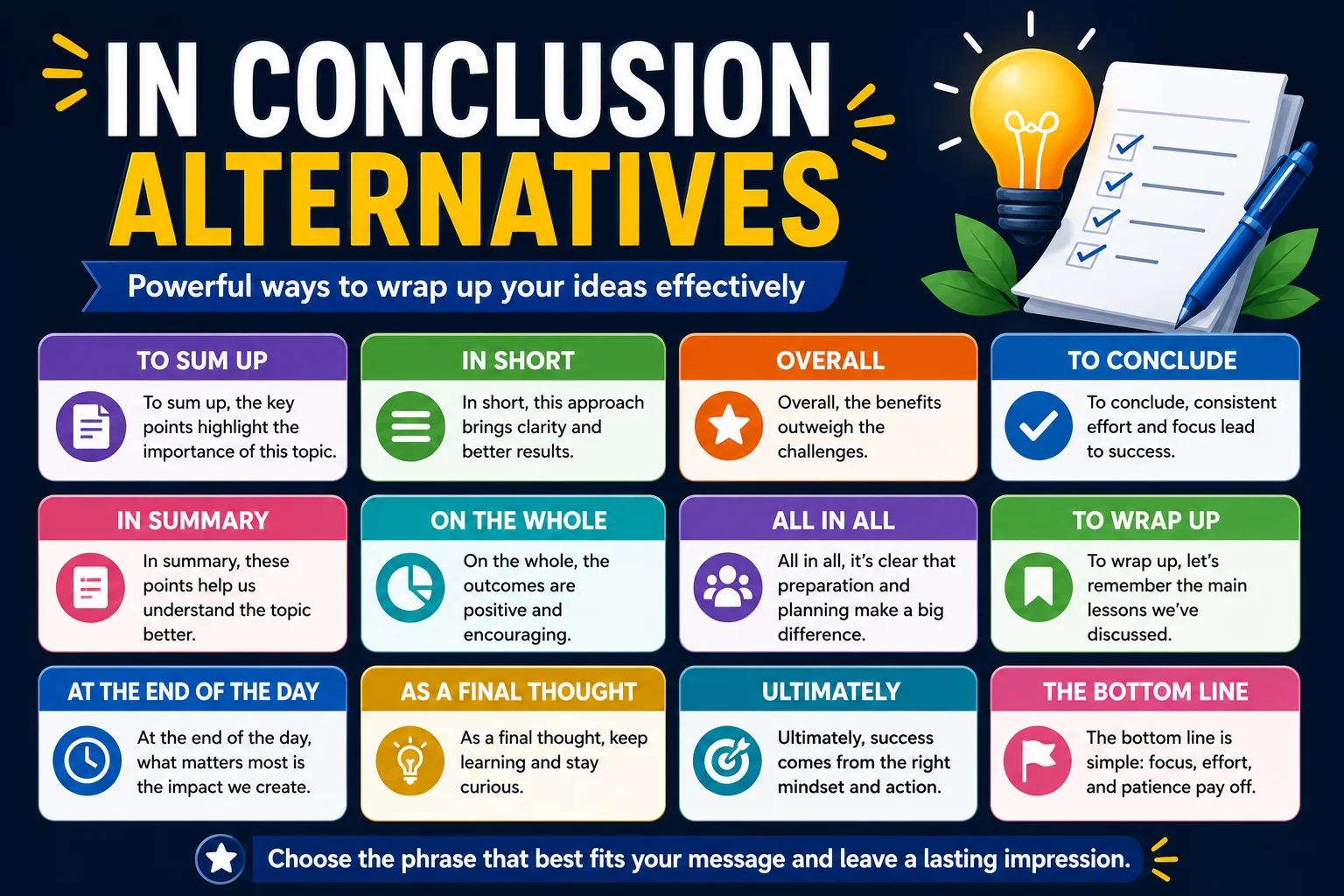
In Conclusion Alternatives Have you ever finished writing an essay, article, report, or email and found yourself automatically typing “in conclusion”?
You’re not alone. Many writers rely on this phrase because it’s familiar and easy to use. However, repeating the same ending phrase can make your writing sound predictable, repetitive, or even outdated. Whether you’re a student, blogger, content writer, business professional, or academic researcher, using stronger alternatives can instantly improve the quality of your writing.
A well-crafted conclusion is important because it leaves the final impression on your readers. The words you choose at the end can reinforce your message, create impact, and make your content more memorable.
The good news is that there are many excellent alternatives to “in conclusion” that sound more natural, professional, persuasive, and engaging.
In this guide, you’ll discover the best in conclusion alternatives for different situations, including essays, academic papers, business writing, presentations, emails, and everyday communication.
Quick Answer: What Are the Best In Conclusion Alternatives?
The best alternatives to “in conclusion” include:
- To sum up
- In summary
- Ultimately
- Overall
- To wrap up
- All things considered
- In closing
- As a final point
- In the end
- Taking everything into account
These phrases help you end your writing smoothly while sounding more professional and less repetitive.
Understanding “In Conclusion Alternatives”
The phrase “in conclusion alternatives” signals that the writer is about to summarize key points and provide final thoughts.
While it is grammatically correct and widely accepted, overusing it can make writing feel formulaic. Modern writing often favors more natural transitions that fit the tone and purpose of the content.
Why Writers Look for Alternatives
- Avoid repetition
- Improve readability
- Sound more professional
- Create a stronger final impression
- Match different writing styles
- Enhance engagement
- Make content feel more natural
Best General Alternatives to In Conclusion Alternatives
These alternatives work in most writing situations.
General Replacements
- To sum up
- In summary
- Overall
- Ultimately
- All in all
- In the end
- To conclude
- In closing
- To wrap up
- As a final thought
Example
Instead of:
“In conclusion, exercise improves both physical and mental health.”
Try:
“Ultimately, exercise improves both physical and mental health.”
Or:
“Overall, exercise improves both physical and mental health.”
Professional Alternatives for Business Writing
Business communication requires concise and polished language.
Professional Options
- In closing
- To summarize
- As a final point
- To wrap things up
- Overall
- Taking everything into account
- Based on the above
- Considering all factors
- In light of these findings
- From this perspective
Examples
- “In closing, we recommend implementing the new strategy next quarter.”
- “Taking everything into account, the project appears highly feasible.”
- “Based on the above, additional investment is justified.”
These phrases sound polished and executive-friendly.
Academic Alternatives for Essays and Research Papers
Students often overuse “in conclusion alternatives” in academic writing.
Better Academic Alternatives
- To summarize
- In summary
- Overall
- Taking everything into consideration
- Based on the evidence presented
- As demonstrated above
- Given these findings
- Therefore
- Consequently
- In light of this analysis
Example
Instead of:
“In conclusion, climate change remains a significant global issue.”
Use:
“Given these findings, climate change remains one of the most significant global challenges.”
In Conclusion Alternatives for Formal Writing
Formal documents require precise language.
Formal Alternatives
- Accordingly
- Therefore
- Thus
- Hence
- As a result
- Consequently
- In closing
- To summarize
- In brief
- In summary
These options help maintain a formal and authoritative tone.
In Conclusion Alternatives for Everyday Writing
Not every conclusion needs to sound academic.
Casual Options
- Anyway
- So yeah
- All in all
- At the end of the day
- Long story short
- To wrap things up
- Bottom line
- In the end
- That’s about it
- The takeaway is
Examples
- “Long story short, the trip was amazing.”
- “At the end of the day, happiness matters more than money.”
- “Bottom line: consistency wins.”
These feel more conversational and reader-friendly.
In Conclusion Alternatives That Sound Unique
Want your writing to stand out?
Creative Options
- The bottom line is
- The key takeaway is
- The final verdict is
- Looking back
- The bigger picture is
- What matters most is
- The essential point is
- The final takeaway
- The central message remains
- The lesson here is
These alternatives add personality and originality.
In Conclusion Alternatives for Presentations
Public speaking requires natural transitions.
Presentation Endings
- To wrap up
- Before we finish
- As we conclude
- Let’s recap
- To summarize today’s discussion
- One final thought
- Before I leave you
- The key takeaway is
- In closing
- To bring everything together
Example
“Before I leave you, remember that small improvements lead to significant results over time.”
This sounds more engaging than simply saying “in conclusion.”
In Conclusion Alternatives for Emails
Professional emails benefit from smoother endings.
Email-Friendly Options
- Thank you for your time
- To summarize
- In closing
- Looking ahead
- Moving forward
- As a final note
- Before we conclude
- To wrap up
- In summary
- With that in mind
Examples
- “As a final note, please submit your feedback by Friday.”
- “Looking ahead, we anticipate continued growth.”
- “With that in mind, we recommend proceeding with implementation.”
One-Word In Conclusion Alternatives
Sometimes less is more.
One-Word Replacements
- Ultimately
- Overall
- Therefore
- Thus
- Consequently
- Hence
- Finally
- Accordingly
- Summarily
- Briefly
These can make your writing cleaner and more concise.
Did You Know?
Many professional editors recommend avoiding repetitive conclusion phrases whenever possible.
Instead of explicitly announcing a conclusion, skilled writers often transition naturally into their final point. This approach creates smoother reading experiences and keeps readers engaged until the final sentence.
For example:
Instead of:
“In conclusion, customer service is important.”
Try:
“Ultimately, exceptional customer service remains the foundation of long-term business success.”
The second version feels more natural and impactful.
What Not to Use Instead of In Conclusion Alternatives
Some phrases can weaken your writing.
Avoid These
- That’s all
- End of story
- Basically
- Whatever
- You get the point
- Needless to say
- Obviously
- Clearly everyone agrees
Why They Fail
- Sound informal or unprofessional
- Can appear dismissive
- Reduce credibility
- May alienate readers
- Lack clarity
Professional conclusions should reinforce your message rather than weaken it.
How to Choose the Right Alternative
The best replacement depends on your audience and purpose.
For Essays
- In summary
- To summarize
- Given these findings
For Business Reports
- In closing
- Taking everything into account
- Based on the above
For Blogs
- Ultimately
- Overall
- The key takeaway is
For Emails
- As a final note
- Looking ahead
- To wrap up
For Presentations
- One final thought
- Before we finish
- The key takeaway is
Matching the phrase to the situation improves communication and professionalism.
75 In Conclusion Alternatives List
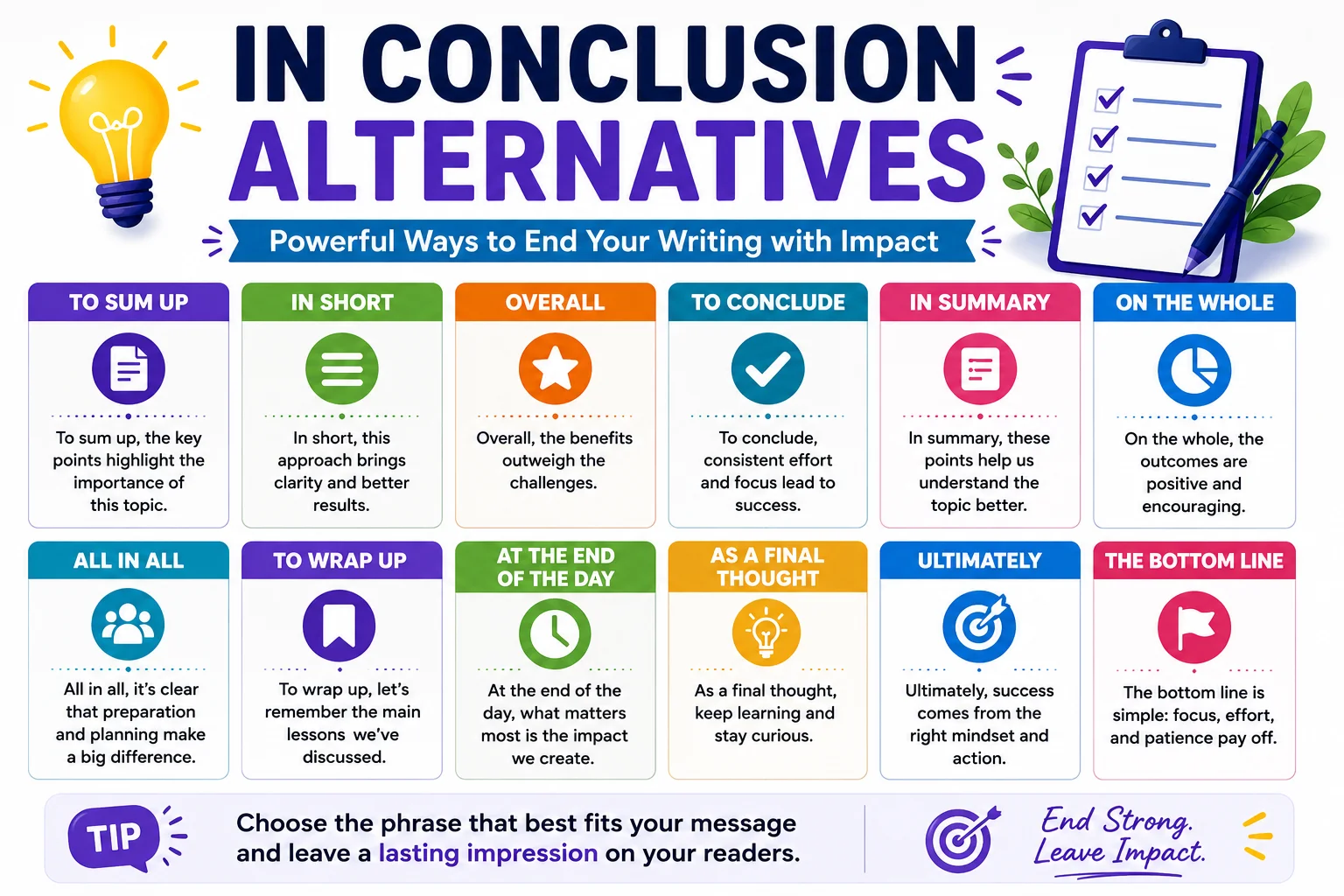
- To sum up
- In summary
- Overall
- Ultimately
- All in all
- In the end
- In closing
- To wrap up
- To conclude
- Finally
- Therefore
- Thus
- Hence
- Consequently
- Accordingly
- As a final point
- As a final thought
- Looking back
- The takeaway is
- The key takeaway is
- Bottom line
- Long story short
- At the end of the day
- To summarize
- Based on the evidence
- Given these findings
- Taking everything into account
- Considering all factors
- As demonstrated above
- From this perspective
- The final verdict is
- What matters most is
- The bigger picture is
- The lesson here is
- In brief
- Briefly
- Summarily
- Moving forward
- Looking ahead
- Before we finish
- Before I leave you
- To bring everything together
- To recap
- Let’s recap
- In light of this
- As a result
- On balance
- After considering everything
- With that in mind
- As a final note
- The central message remains
- The essential point is
- The final takeaway
- The conclusion is clear
- This shows that
- It follows that
- Therefore, we can see
- Overall speaking
- Broadly speaking
- To put it simply
- To make a long story short
- In retrospect
- Upon reflection
- The evidence suggests
- The facts indicate
- The results show
- The findings reveal
- The outcome is clear
- The final consideration is
- In essence
- At its core
- Most importantly
- Above all
- To close
Frequently Asked Questions
What is the best alternative to “in conclusion”?
The best alternative depends on the context. For most situations, “ultimately,” “overall,” “to sum up,” and “in summary” are excellent choices because they sound natural, professional, and versatile.
Is it okay to use “in conclusion” in academic writing?
Yes, it is grammatically correct and acceptable in academic writing. However, many teachers and editors prefer more varied transitions such as “in summary,” “given these findings,” or “to summarize.”
Why should I avoid overusing “in conclusion”?
Overusing the phrase can make writing sound repetitive and predictable. Using varied alternatives helps keep your content engaging and demonstrates stronger writing skills.
Which alternative sounds most professional?
“In closing,” “taking everything into account,” and “based on the evidence presented” are among the most professional alternatives for reports, business documents, and formal communication.
Can I use one-word alternatives?
Yes. Words such as “ultimately,” “therefore,” “thus,” and “consequently” can effectively replace “in conclusion” while making writing more concise.
What is the best alternative for presentations?
For presentations, phrases like “to wrap up,” “one final thought,” “before we finish,” and “the key takeaway is” sound natural and engaging.
Final Thoughts
Finding strong in conclusion alternatives can instantly improve the quality of your writing. Whether you’re working on an essay, blog post, business report, presentation, or email, choosing the right concluding phrase helps create a stronger and more memorable ending.
Instead of relying on the same phrase every time, experiment with options like ultimately, overall, to sum up, in closing, and the key takeaway is. These alternatives sound more natural, improve readability, and leave readers with a lasting impression.
Which alternative do you use most often? Try a few new options in your next piece of writing and see how much more polished your content feels.