
You receive a text message that simply says:
“Sounds good 😊”
Seems harmless, right?
But what if that same smiley face means friendliness, gratitude, politeness, flirting, sarcasm, or even passive-aggressive behavior depending on the conversation?
Welcome to the fascinating world of smiley face emojis.
What started as simple digital expressions has evolved into an entire language used by billions of people every day. Whether you’re texting friends, chatting with a crush, posting on Instagram, commenting on TikTok, or communicating with coworkers, smiley face emojis help express emotions that words alone often cannot.
The challenge is that many smiley emojis now have multiple meanings.
A simple 🙂 can mean happiness in one conversation and awkwardness in another. A 😉 can signal a joke, flirting, or an inside reference. Even the most innocent-looking smile can completely change the tone of a message.
This guide breaks down the most popular smiley face emojis, their hidden meanings, texting interpretations, social media uses, and real-world examples so you’ll always know exactly what they mean in 2026.
👉 Quick Answer Box
What Are Smiley Face Emojis?
Smiley face emojis are digital facial expressions used to communicate emotions, reactions, tone, and personality in online conversations. They can represent happiness, laughter, excitement, friendliness, love, confidence, sarcasm, or affection depending on the specific emoji and the context in which it is used.
Understanding Smiley Face Emojis
Smiley face emojis help people communicate emotions visually.
They make messages:
✔️ Friendlier
✔️ More expressive
✔️ Less confusing
✔️ More engaging
✔️ More personal
Without emojis, text messages can sometimes seem cold or unclear.
Compare:
- “Thanks.”
- “Thanks 😊”
The second version feels much warmer.
That’s the power of smiley face emojis.
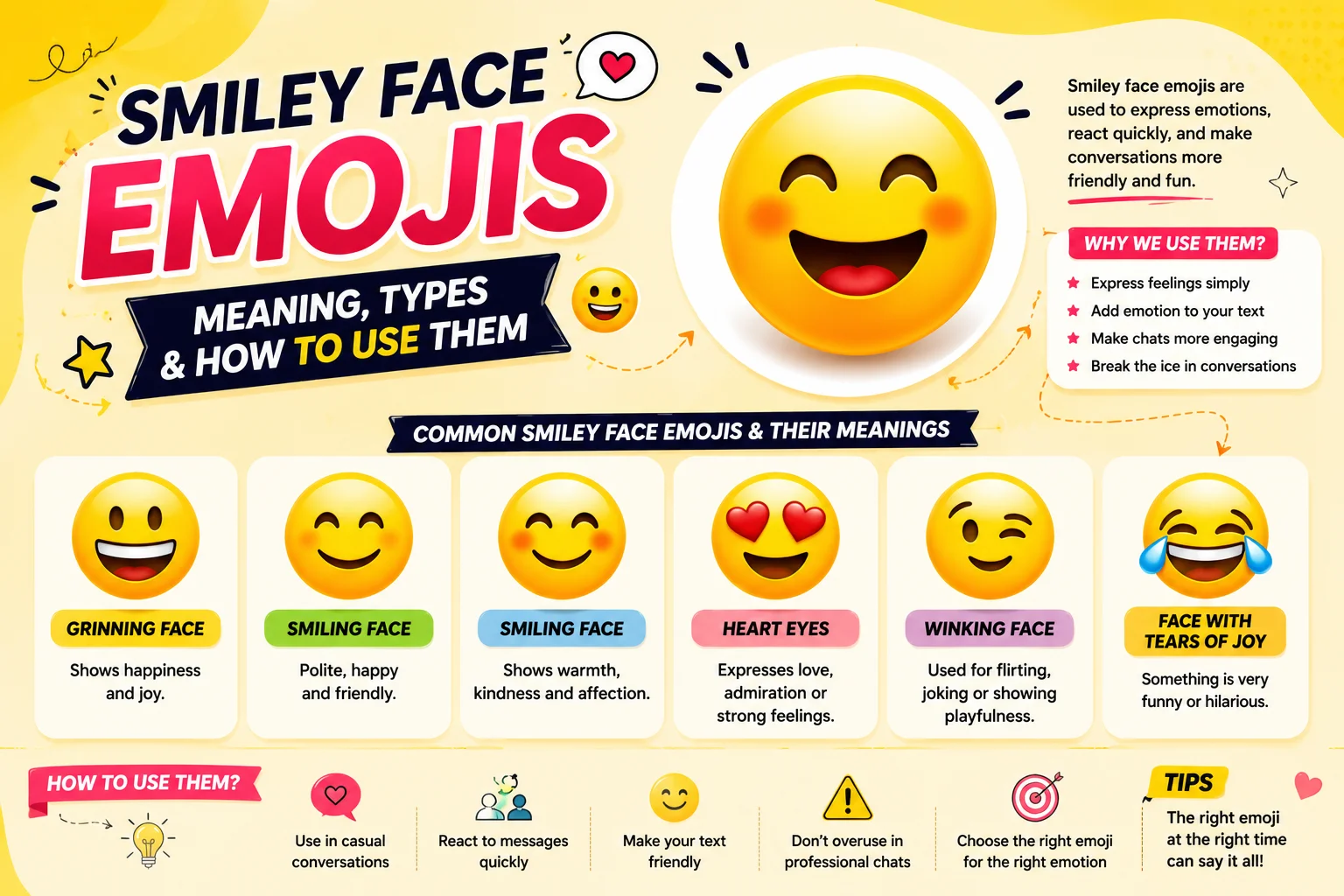
Most Popular Smiley Face Emojis and Meanings
😊 Smiling Face With Smiling Eyes
Meaning:
- Genuine happiness
- Kindness
- Gratitude
- Warmth
Example:
“Thank you for helping me 😊”
Vibe: Friendly and sincere.
😀 Grinning Face
Meaning:
- Excitement
- Happiness
- Positive energy
Example:
“I passed my exam 😀”
Vibe: Enthusiastic.
😄 Grinning Face With Smiling Eyes
Meaning:
- Joy
- Cheerfulness
- Fun
Example:
“That was an amazing day 😄”
Vibe: Upbeat and positive.
😁 Beaming Face
Meaning:
- Pride
- Achievement
- Satisfaction
Example:
“I finally finished the project 😁”
Vibe: Accomplished and excited.
😂 Face With Tears of Joy
Meaning:
- Extreme laughter
- Something hilarious
Example:
“That meme was hilarious 😂”
Vibe: Funny and energetic.
Happy Smiley Face Emojis 😊
These emojis are used when expressing happiness.
Popular Happy Emojis
- 😊
- 😀
- 😄
- 😃
- 😁
- 🤗
- ☺️
- 😇
- 🥳
- 😸
Best Situations
- Celebrations
- Positive news
- Thank-you messages
- Friendly conversations
- Family chats
When to use: Everyday conversations.
Vibe: Positive and welcoming.
Laughing Smiley Face Emojis 😂
These emojis are designed for humor and laughter.
Most Common Laughing Emojis
- 😂
- 🤣
- 😹
- 😆
- 😅
Examples:
- “I can’t stop laughing 😂”
- “That’s the funniest thing I’ve seen 🤣”
- “You’re kidding 😆”
When to use: Memes, jokes, funny videos.
Vibe: Playful and entertaining.
Flirty Smiley Face Emojis 😘
Not every smiley emoji is innocent.
Some are commonly used in flirting.
Popular Flirty Emojis
- 😉
- 😘
- 😍
- 🥰
- 😚
Examples:
- “You looked amazing tonight 😍”
- “Sleep well 😘”
- “I see what you did there 😉”
When to use: Dating, crushes, romantic conversations.
Vibe: Affectionate and playful.
Cool and Confident Smiley Face Emojis 😎
These emojis communicate confidence and attitude.
Common Confidence Emojis
- 😎
- 😏
- 😌
- 🤩
- 😋
Examples:
- “Mission completed 😎”
- “I knew I could do it 😏”
When to use: Celebrating success.
Vibe: Confident and relaxed.
Hidden Meanings Behind Smiley Face Emojis
Some smiley emojis have meanings beyond their official descriptions.
😏 Smirking Face
May indicate:
- Flirting
- Confidence
- Teasing
- Suggestiveness
🙂 Slightly Smiling Face
May indicate:
- Politeness
- Forced positivity
- Mild awkwardness
🙃 Upside Down Face
May indicate:
- Sarcasm
- Irony
- Frustration
😬 Grimacing Face
May indicate:
- Nervousness
- Embarrassment
- Awkward situations
Context matters more than the emoji itself.
Smiley Face Emojis in Text Messages
Different smileys create different tones.
Friendly Texting Emojis
- 😊
- 😄
- 🤗
Funny Texting Emojis
- 😂
- 🤣
- 😆
Romantic Texting Emojis
- 😘
- 😍
- 🥰
Casual Texting Emojis
- 🙂
- 😌
- 😎
Micro-answer:
What smiley emoji is safest to use?
😊 is generally the safest and friendliest option.
Smiley Face Emojis on Social Media
Social media users often use smiley emojis to:
✔️ Increase engagement
✔️ Show personality
✔️ Add emotion
✔️ Make captions stand out
Examples:
- “Best day ever 😎☀️”
- “Dreams do come true 😊”
- “Weekend vibes 😄”
Emoji-rich captions often appear more relatable and engaging.
Smiley Face Emojis by Situation
Talking to Friends
- 😂
- 😄
- 🤣
- 😊
Talking to Your Crush
- 😉
- 😍
- 🥰
- 😘
Talking to Family
- 🤗
- 😊
- 😇
Workplace Conversations
- 🙂
- 😊
- 👍
Social Media Posts
- 😎
- 🤩
- 😄
Using the right emoji improves communication.
Did You Know? 🤔
Researchers have found that messages containing smiley face emojis are often perceived as more friendly and emotionally expressive than plain text messages.
Even a single smile emoji can significantly improve how a message is received.
That’s why smiley face emojis remain among the most frequently used emojis worldwide.
Common Mistakes When Using Smiley Face Emojis
Avoid these mistakes:
❌ Using too many emojis in professional communication
Why it fails:
- Appears unprofessional.
❌ Using 😏 accidentally
Why it fails:
- May sound flirtatious.
❌ Mixing contradictory emotions
Example:
😂😭😍😡
Why it fails:
- Confuses readers.
❌ Replacing words entirely with emojis
Why it fails:
- Reduces clarity.
❌ Using laughing emojis during serious conversations
Why it fails:
- Can appear insensitive.
Frequently Asked Questions
What is the most used smiley face emoji?
The Face With Tears of Joy emoji (😂) remains one of the most used smiley face emojis because it clearly communicates laughter and humor across cultures and platforms.
What does 😊 mean in texting?
The 😊 emoji typically represents kindness, happiness, appreciation, gratitude, or friendliness. It is considered one of the safest and most universally positive smiley face emojis.
What does 😉 mean from a crush?
The wink emoji often suggests playful teasing, flirting, attraction, or an inside joke. However, context and the overall conversation are important when interpreting its meaning.
Which smiley emoji is best for professional communication?
The 😊 and 🙂 emojis are generally the safest options in workplace communication because they appear friendly without being overly casual or emotional.
Why are smiley face emojis so popular?
Smiley face emojis help people communicate emotions visually, making messages feel warmer, clearer, and more engaging than plain text alone.
Can smiley face emojis have hidden meanings?
Yes. Certain smiley emojis such as 😏, 🙃, and 🙂 can carry hidden meanings like sarcasm, flirting, irony, or passive-aggressive humor depending on the situation.
Conclusion
Smiley face emojis are much more than tiny digital pictures. They help express emotions, strengthen relationships, clarify tone, and make conversations feel more human.
Whether you’re using 😊 for kindness, 😂 for laughter, 😍 for admiration, 😎 for confidence, or 😉 for playful flirting, understanding emoji meanings can help you communicate more effectively online.
The next time someone sends you a smiley face emoji, you’ll know exactly what message they may be trying to send.
Which smiley face emoji do you use most often? Share your favorite and let everyone know why it’s your go-to emoji!